Parasola conopilus




Description
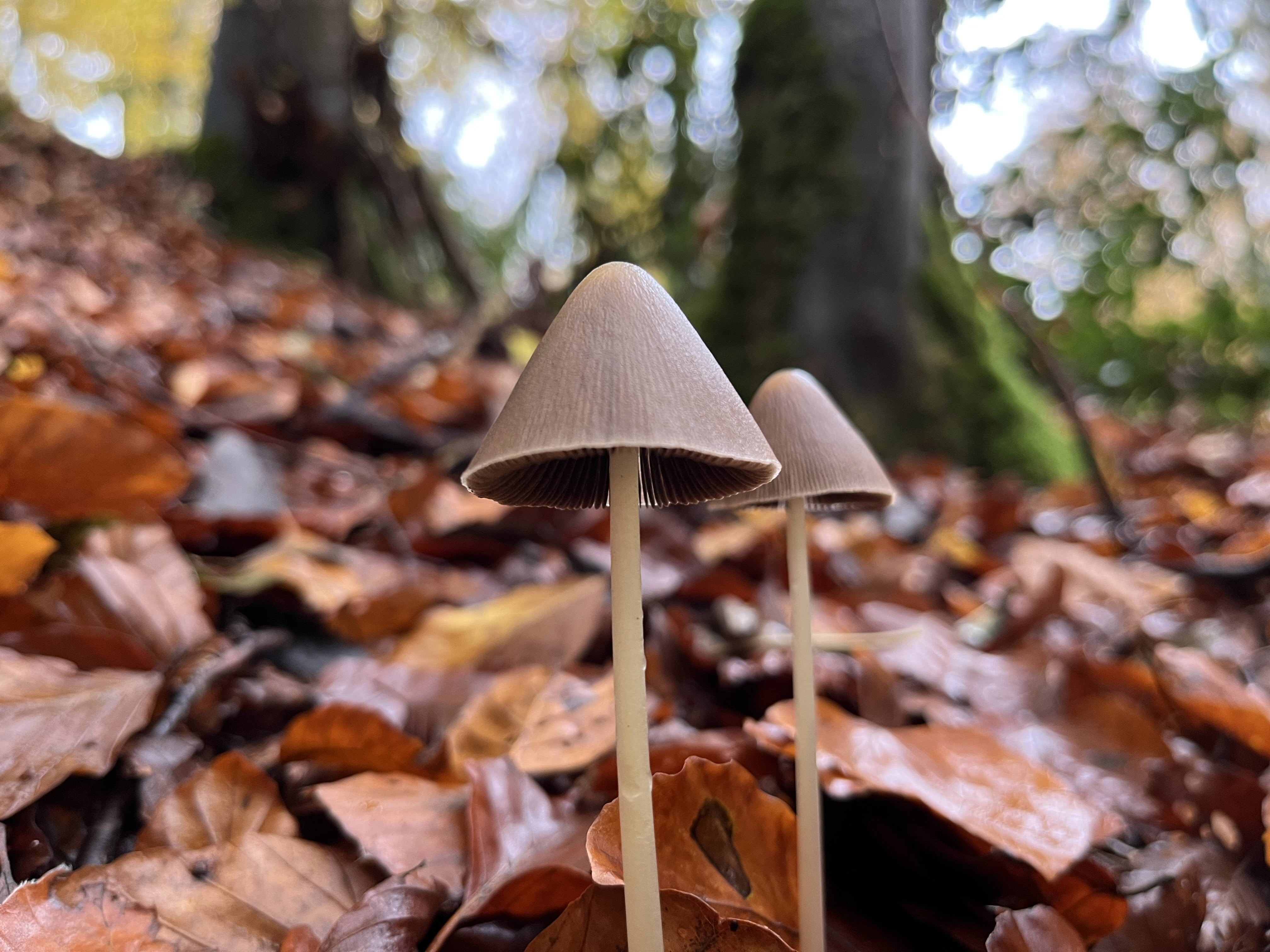
Parasola conopilus is a deep rich brown mushroom. When young has hairs that can be seen with a lens. The cap fades to pale beige with age. Gills are brown with a purplish tint. Stalk (stipe) is long, slender, and white, soon hollow and brittle.
This mushroom grows gregariously, but usually not in clusters; this fact will help separate it from the western North American species Psathyrella atrospora, which is very similar, but smaller and usually found in dense clusters—and from Psathyrella circellatipes, which is also similar but grows in dense clusters and features orangish hairs on the cap and stem base when young.
Like so many hygrophanous mushrooms, once the caps have dried they lose their luster and become matt and very much paler and in very dry conditions, they turn almost white. The color change begins at the center, so that the caps pass through a two-tone stage, as shown above.
Common names: Conical Brittlestem.
Mushroom Identification
Ecology
Saprobic; growing scattered to gregariously or in loose clusters of 2–4 mushrooms (but not densely clustered) from the deadwood or litter of hardwoods, or dung; found in hardwood forests or cultivated areas; spring and fall; widely distributed in North America; also found in Europe and Australasia.
Cap
2–5 cm; conic, becoming broadly conic, broadly bell-shaped, or more or less convex; bald or, with a hand lens, with tiny projecting hairs; sometimes becoming radially wrinkled; reddish-brown, fading to pale tan; changing color markedly as it dries out; without veil remnants; the margin not lined.
Gills
Narrowly attached to the stem; close or nearly distant; pale brownish at first, becoming dark gray to nearly black; short-gills frequent; with whitish edges.
Stem
5–13 cm long; 2–4 mm thick; equal; fragile; becoming hollow; bald; white; without a ring; basal mycelium white.
Flesh
Thin; fragile; pale, watery brownish.
Spore Print
Black.
Microscopic Features
Spores 14–18 x 6–8 µm; ellipsoid, with a pale pore; smooth; dark brown in KOH; dark brown in Melzer's. Basidia 4-sterigmate; abruptly clavate. Brachybasidioles present. Cheilocystidia abundant; 35–50 x 12.5–17.5 µm; lageniform, often with a fairly long neck, or subcylindric, subutriform, or sphaeropedunculate; smooth; thin-walled; hyaline in KOH. Pleurocystidia not found. Pileipellis hymeniform-cellular; elements 15–25 µm across, irregularly subglobose, smooth, hyaline in KOH; setae 200–250 x 2.5–5 µm, aciculate, thick-walled, reddish-brown in KOH.
History
The Conical Brittlestem was described in 1786 by German mycologist August Johann Georg Karl Batsch (1761 - 1802), who gave it the scientific name Agaricus subatratus; however, it was Swedish mycologist Elias Magnus Fries who, in 1821, established the basionym (first valid epithet) of this mushroom, naming it Agaricus conopilus.
The currently accepted scientific name of the Conical Brittlestem, Parasola conopilus, was established in 2008 by Swedish mycologists Leif Örstadius & Ellen Larsson.
Synonynms of Parasola conopilus are many and include Agaricus subatratus Batsch, Agaricus conopilus Fr., Agaricus superbus Jungh., Agaricus aratus Berk., Psathyra conopilus (Fr.) P. Kumm., Psathyrella subatrata (Batsch) Gillet, Drosophila conopilus (Fr.) Quél., Agaricus conopilus f. superbus (Jungh.) Cooke Agaricus conopilus var. superbus (Jungh.) Cooke, Psathyra elata Massee, Psathyrella arata (Berk.) W.G. Sm., Psathyrella conopilus (Fr.) Ulbr., and Psathyra conopilus var. subatrata (Batsch) J. E. Lange.
The specific epithet conopilus means with a conical cap.
Video
Photo copyright:
All photos were taken by the Ultimate Mushroom team and can be used for your own purposes under the Attribution-ShareAlike 4.0 International license.


